
Dichotomy
Part 2
By John Drewry
‘The long way’ meant travelling about 400 miles by inland waterways, a fabulous journey of blue and green. Above ground, almost all the UK mainland was rural countryside, deliberately slow-moving, no roads, no motorised vehicles, but connected by a resurrected, long-ago planned network of national waterways linking canals with rivers, so you could leisurely move goods, or people, or water itself from any part of the country to another. If you needed speed, you went underground.
There was a major canal at Glaschu feeding off the Clyde Watter and running south over the course of an ancient motorway from the days of cars and lorries. This in turn joined up with a myriad of liquid arteries and capillaries in every direction. Alfred and Alastair boarded the ‘BALACH DONA’, a double-width barge which would take them as far as Mancunio, where they’d have to change. There would be a stop at Robot City to pick up some manufactured goods like domestic appliances. After all, although the people revered their bucolic environment above ground, try telling Alfred’s mum to go back to beating clothes with stones by the riverside! There’s a world of difference between a chore like laundry and the satisfaction of baking fresh bread. So families had machines from Robot City which could wash, dry and do the ironing! Mind you, mum did like hanging out clothes to air in the garden, for there is nothing to beat the fresh sensation of putting on a shirt blown dry by Nature.
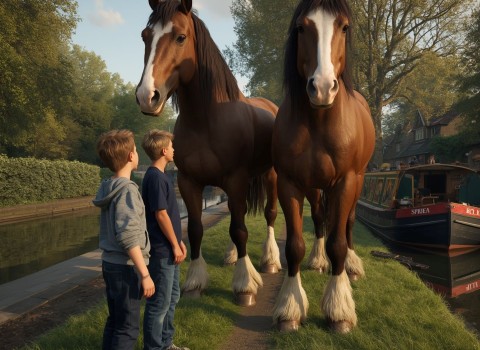
Alastair said hello to the two shire horses, who blew steam all over him from their nostrils. These magnificent beasts could haul fifty times the weight of a land-based load on water. The two boys managed to secure a small cabin for themselves. The captain seemed a bit of a gruff fellow, but he softened pretty quickly when Alastair pointed out that one of the horse’s shoes was loose, and then promptly fixed it. In Glaschu, he regularly spent time with the local farrier, learning all he could.
The boys also established that there were two teachers on board, so they registered for tuition. This meant mum’s wishes would be fulfilled. It also meant they could earn some credits, because they’d both exhausted their funds paying for the journey.
“Come on, boys”, called the skipper firmly, and with acknowledging snorts Angus and Darach hauled the grand barge into motion. Whilst Alfred was always thrilled by the acceleration to twice the speed of sound of an underground pod, he found nothing quite equalled the slow, silent, pulling away of a horse-drawn barge on the water. He gazed at the two big bottoms ahead on the towpath, in rhythm with each other and with the barge and with the skipper and with himself and with Alastair and with the world around them, and mused on how close the previous civilisation had come to losing the likes of Angus and Darach forever, wonderful spirits whose only desire was to please you and to be part of your life. “That’s until one of them steps on your foot”, said Alastair, rather shaking Alfred out of his reverie, “that will make you swear”. But in truth he felt the same, even more so, and was only joshing.
The countryside drifted lazily by. They passed hamlets, villages and small towns, each served by fields, livestock and orchards. Everything these days was local, independent and self-sufficient. Farms were small, serving almost exclusively their local communities, as were butchers and bakers. Centralised, mass production and distribution of food had disappeared, and with it the destructive ugliness of its wake. Candlestick makers were rather more rare but not entirely extinct. Most folk wanted electric light and other modern home comforts, but a few took the rural environment more literally, and chose to use candles. There were no houses or buildings taller than two storeys.
These days, horses drew the plough once more, as well as providing, with their other free-range, livestock companions, the manure for natural fertilisation. On the ground, the only means of transport was pony or Shanks’s pony. But a pod station was normally within twenty minutes’ walk for those in a hurry. Only for something like a medical emergency would air A+E hover into view. Otherwise, flight was exclusively the domain of the birds and the bees (and fellow insects). There were no spy cameras. Indeed, photography was generally frowned upon outside of Robot City. Alfred remembered trying to show a photograph he had taken to one of his teachers, who said “Put it face down, now tell me what you saw, what you heard, what you touched, what you smelled, what you tasted. You have five senses. Photography only communicates to one of them. And very poorly at that”. There were absolutely no drones.
The skipper found a couple of rods for the two boys, and their first day on the water was spent fishing and playing Monopoly, a popular board game that had survived history. There were, of course, an infinite number of electronic games in the cloud, constantly being added to by Robot City, but ‘tactile’ games had become an important part of people’s leisure these days. There was extra pleasure in moving physical pieces across a physical board, and exchanging ‘filthy lucre’.
They managed to catch a couple of fresh perch, which found their way to the skipper’s table. He liked these two boys. The following day they met their teachers. Many teachers were itinerant these days, in between school sojourns, travelling on the water and hopping from boat to boat, rather like the Mississippi gamblers of the 19th Century. Getting educated was voluntary, for anyone from five onwards, with no upper age limit. You could choose your days, your locations, your subjects and your teachers. You might think this was an incentive for children and young people to become permanent truants. But there was a much bigger incentive. You were paid to learn. This was the carrot. Each day that you opted for tuition, you notched up credits which you could spend. ‘Don’t learn, don’t earn’ was a common mantra. ‘Don’t learn, can’t spend’ was a popular, non-rhyming variation. State benefit didn’t exist for the healthy – you had to earn it. The stick was that if you didn’t behave reasonably, there was no obligation to teach you, and you didn’t earn.
Two old buffers greeted them. Teachers were always old. The minimum age to become a teacher was fifty-five. So, especially to children, they always appeared ancient and ‘professorial’, usually with the twinkle of benign wisdom in their eyes, very much like wizards. They’d been through all the usual hoops of extremism, fanaticism, campaigning and changing the world. In short, they tended to end up knowing what they were talking about. And teaching these days was fundamentally conversational, in small groups, with questions and answers, fired almost as banter back and forth. The serious game of debate, the lighting of a flame. “I’m Hargreaves, this is Crabtree”, said the teacher with the beard, “he’s Anthropology, I’m History. We very much work together”. Crabtree had no beard or indeed the sign of any potential hair on his face. He was as smooth as a baby, with quite a high-pitched voice. He reminded Alfred of Chaucer’s Pardoner: “Methinks he were a gelding or a mare”. Most children knew their Chaucer well. The boys’ favourite, naturally, was the Miller’s Tale, for which Alfred, of course, was constantly taunted, being Alfred Miller. “Alfred let fly a fart as ‘twere a thunderclap, he was near blinded by the blast, poor chap”, they would risibly chant at school. Boys will be boys. Some laws had had to be resurrected, such as the offence of setting light to horses’ farts, a favourite boys’ pastime in ancient days.
They were joined by another student, an old lady well into her eighties. Tutelage was available to anyone of any age. Many retirees supplemented their pensions with some education when it suited them, not just for the credits but for the joys of conversation and learning. Old age was revered and rewarded in this epoch. The boys had a habit of inventing nicknames for their teachers and decided that Hargreaves and Crabtree were Socrates and Plato respectively, not particularly in homage to Greek philosophy but rather to emphasise their old fartness. It was done with affection, though, and children remembered many of their old teachers with an emotional, trembling lower lip when they were old themselves. “Give me your phones, people”, said Plato, and he touched them on his device. “Ah, Alastair”, he observed on his screen, “I see you’re doing very well with English Literature under Gregory. How is the old cove, haven’t seen him for years?” “A bit forgetful”, replied Alastair, “he makes us laugh sometimes, you know, ‘was it Shakespeare, was it Marlowe, was it me?’”, he mimicked a doddery old man with a shaky voice. “He was always like that”, laughed Plato, “even when he was young. We could never work out whether it was just an affectation. No matter, there is no finer authority on the subject. Use him while you’ve still got him. He’s a dear man. Oh, and Griselda”, he continued, turning to the old lady, “a First in Classics, I see”. Alfred and Alastair exchanged a private smirk – Griselda wouldn’t need a nickname! Plato would be touching their phones on his device again at the end of the day to enter the credits all three students would have earned for the day’s tuition.
“We observed you playing Monopoly yesterday”, said Socrates, “what say we all have a game now?” This suggestion thrilled but didn’t particularly surprise the boys. Wisdom and games are close companions, and there would be much animation, interaction and sharing of knowledge. Griselda turned out to be a ruthless Monopoly player.
Both boys were interested in the function and history of money, which cut across the specialisms of both tutors. “In a nutshell”, said Plato as he gleefully landed on Mayfair and bought a hotel, “money is a means of exchange. I’m sure you’re already acquainted with that term. It’s cumbersome and in the end impractical to trade two chickens for a week’s supply of potatoes, so we use a common currency with an agreed value to acquire what we want. So far, so good. It’s when money, which you can’t eat, talk to or ride upon, becomes desired for itself, to be coveted and worshipped for its power, that the problems begin. Two thousand pounds, please”, he cried greedily to the hapless Socrates who’d just landed on his property. “That’s the bit we don’t quite understand”, said Alastair. “Look”, said Socrates, “we’re playing Monopoly, aren’t we? The winner is he or she who acquires all the money. Well, what happens at the end of the game?” “We put everything back in the box”, replied Alastair. “Exactly”, Socrates continued, “but what if the winner refused to put the money back in the box?” “Then we couldn’t play another game”, replied Alastair. “That’s right”, Plato agreed, “game over. Now, here it gets interesting. What if the winner said he or she would consider putting the money back if you gave them a head start in the next game, say a property or two?” “That would be unfair”, Alfred exclaimed, “I wouldn’t like that person”. And it wouldn’t be fun anymore”, added Alastair. “Indeed, most important”, Plato agreed, “playing by the agreed rules of the game means a safe framework for having fun. Having fun is so important, sharing fun is even more important. At the end of the game, everything has to go back in the box and you can begin again. It’s a metaphor, and I believe you understand this. The flow of money, people earning and people spending, is like the flow of blood through the body. It winds its way through the system and back to the beginning again, just like the pieces on a Monopoly board”. “While we’re on metaphors, here’s another”, added Socrates, “healthy money flows like water. But if someone dams it up and stops the flow, everybody else’s water becomes stagnant. When the flow stops, the fun stops.”. The barge stopped as they reached a series of locks. “Just a temporary dam”, Socrates smirked, “not the same thing”.
They all broke the game to watch the simple magic of a hydraulic staircase, enabling craft ostensibly to climb up and down hills. Soon afterwards, Griselda won the Monopoly game with a triumphant cackle.