
Dichotomy
Part 7
By John Drewry
“I want to know more”, said Alastair, “this is what I’ll want to do with my life”. “Then come and see me”, Deadly replied, “I teach at Robot City’s medical research laboratories on occasion. In the meantime, get hold of a comprehensive Materia medica, and study the effects of every known substance in Nature upon the body”. “Can you make love potions?”, asked Alastair. Socrates and Alfred both knew why he had asked this question. “Ah”, Deadly responded, “l’elisir d’amore, did you have someone in mind? No, I’m sorry, no amount of boiling, bottling, chanting or leaping through the fire can make someone fall in love with you. Having said that, very sophisticated perfume can make someone attractive. The finest perfumes have no smell at all, not to the conscious mind at least. But they find their way into the brain, and can make a woman irresistible”. The person Alastair had in mind was already irresistible, it was himself he’d been hoping to transform in her eyes. “We look at the iris”, Deadly continued, “and the agar tree for those ingredients. Or Ambergris, from the intestine of the majestic sperm whale, bless him. Then there is that final adjustment, what some would call the magic ingredient”, he added mysteriously, but wouldn’t be drawn further.
“I don’t know why you like her”, said Alfred, “she’s bossy, just like my sister”. He was right, Bessie was a 26-year-old who brooked no nonsense with anyone. She skippered her barge with a rod of iron. This filled Alastair with admiration and love, and he spent as much time as possible in her company, much to Alfred’s disdain. He would chat away to her, run errands for her, do everything he could to shine in her beautiful eyes. But when Alastair said he wanted to stay on the boat with her forever, she put him straight. “Young man”, she said, “I don’t intend to spend the rest of my life on a barge. I want to captain an oceangoing vessel some day, one with big engines, out on the high seas visiting other countries”. “I must train to be her ship’s doctor”, Alastair resolved to himself immediately. Bessie put her arm round him, and Alastair felt as though he would swoon. “Why don’t you seek me out in seven- or eight years’ time”, she suggested, “when you’re old enough and I’m where I want to be?” She was, of course, patronising him in a kindly way, but the broken-hearted Alastair vowed eternal commitment to that suggestion. Well, for a few days, anyway.
They were nearing Londinios. Plato had recovered (though Socrates was still complaining about the smell of onions and horseradish in their cabin) and the four of them were once more round the Monopoly board, which served again as a useful metaphor in a relaxed teaching environment. Its originators could never have imagined how useful it would be in this context. Alastair had landed on Mayfair, owned by Socrates, and didn’t have the money to pay up. “You’ll have to mortgage a couple of your properties”, said Socrates with a rather evil chortle. He knew this was likely to bankrupt Alastair. “Always, remember”, he said, “there was a time when this wasn’t a game. The Killjoys encouraged people to borrow money they didn’t have and hadn’t yet earned. Can you see the problem here?” “You have to pay it back”, replied Alfred, “but why’s that wrong?” “It isn’t so much a question of what’s right or wrong”, Socrates explained, “it rather depends what world you want to live in. The problem is, you have to pay back more than you borrowed. The extra is called Interest. Gradually, if you slip into that world, you borrow more and more money. The Killjoys become your master and you their slave. You have to work harder and harder just to pay them back. Why do you think this board game is called Monopoly? Monopoly means that a smaller and smaller group of people get to own everything, by luck, theft, cunning and subterfuge. The difference between that and the game is that it doesn’t all go back in the box. The game doesn’t end”. “Or rather”, added Plato, “it ends badly. A world of slaves ruled by the Killjoys.
“So, tell me how we prevent that happening again. Where does money come from?”. “From the bank”, Alfred chirped. “And how do you get it?”, asked Socrates. “Like now”, replied Alastair, “by learning”. “Correct”, said Socrates, “each day you register with a teacher, he or she swipes your device and the bank credits it with money you can then spend. Similarly, Crabtree and I swipe our own devices and get paid for teaching you. Money is also credited automatically to pensioners. The engineers, scientists and researchers at Robot City, who also control and service the underground transport system, get paid by the bank. As people then spend their credits, that’s how money flows through the system. What about your fathers and mothers, how do they get money?” “Well, my Pa’s a miller”, replied Alfred, “so he grinds the wheat he buys from the farmer, and sells his flour to the bakers. He also gives some to my Ma, because she’s a baker, and she sells her bread”.
“Nice and simple”, said Plato, “so we see that money originates from the bank and moves around, enabling people to buy and sell goods and services. But it has to find its way back to the bank, back to the box. It has to go all the way round the board and back to the beginning. Otherwise, the bank will just keep issuing more and more money, which will then lose its value. Now, much of this happens automatically. Each time you pay your electricity bill, this goes to Robot City and therefore to the bank. This applies equally to anything else you buy from Robot City, including their domestic appliances and manufactured goods, tourist and entertainment attractions, and of course each time you use the underground transport system”. “No-one cares how much you earn”, added Socrates, “provided you spend it. What you can’t do is accumulate it ad infinitum, or combine incomes in companies. And how do we prevent that happening?” “The Cap”, shouted both boys. “That’s right, boys, the Cap”, Plato confirmed, “if you reach the Cap in your credits, you’ll find you can’t add any more. You have to start spending. And what is the final outcome? Are we all equal?”. “No”, they chimed in unison, “but nobody gets too rich or too poor”.
“Londinios”, shouted Bessie from the bow. As with Robot City, it was obvious where they’d arrived, but skippers do like the sound of their own voices. There was the majestic Thames, glowing orange in the sunset. There were the great ships. Alastair thought of Bessie at the helm of one, and him on board as her doctor. Here the boys would part company with Plato and Socrates, and catch a smaller barge to Croindone. “Alfred”, said Plato, “a parting word of advice. I know from one of our previous conversations that you’re keen to pursue an engineering career. You must, dear boy, attain a sound understanding of mathematics. Now, Cressida Hardwyke runs the best school of mathematics and music in the country. It’s at Belerion, previously known as Land’s End, a much better name for it, in my opinion, it says what it is, land’s end, but no matter, you know why we changed back to original names, the people were so incensed by the Killjoys’ deliberate attempts to erase their history that they went into oversteer, and good for them. Anyway, what was I saying? Oh yes, so, half your earnings will go on an hour’s pod travel every day, but well worth it. Cressida runs the school on the Pythagorean principle. Pythagoras averred that there is an intimate relationship between mathematics and music. Music is based upon mathematical forms. And mathematics has its own music. Cressida claims that you’ve become a mathematician when you can see the numbers dancing and hear them singing. Like the ‘music of the spheres’ so aptly described of the planets by the prophets from ancient times. So, you’re likely to emerge from Cressida’s school as a mathematician with proficiency in at least one musical instrument. Goodbye, my boy. Find me if you need me. You know how to”. And with that, he and Hargreaves were gone.
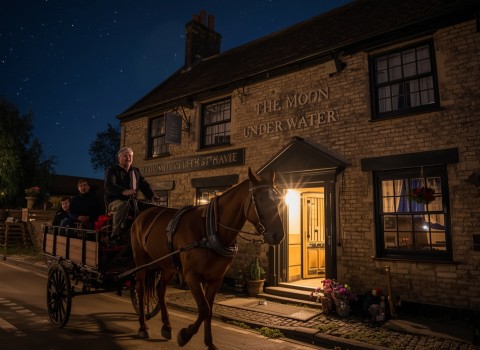
Alfred suddenly felt very homesick. “Alastair”, he said, “would you mind if we cut our journey short and took the pod?” “No”, Alastair replied, feeling the same way but for a different reason. Alfred called Pa, who told him he could get to Croindone pod station in fifteen minutes to pick them up. So, after a few minutes mooning around the docks watching visitors disembarking from the big ships and the cranes unloading, the boys caught the pod to Croindone, and five minutes later there was Pa, still dusty from his work. “Jump up”, he said, “I thought we’d go the pretty route”. The boys knew what this meant, and so did Grimbold, who plodded straight for Pa’s favourite pub. The sky at night was black and beautiful, untroubled by any street lighting. Instead, the moon and stars shone brightly, and the landscape was littered with blobs of light from the windows of dwellings, looking rather like glow-worms in the dark.
The boys started telling Pa about their adventures, and in about half an hour they reached the pub. Well, actually they heard it before it came into view, such was the ribald singing emanating from its windows and doors. It wasn’t entirely surprising, given that all pubs dispensed home brewed and distilled concoctions of varying and suspicious strengths. The barley wines and poteen were particularly lethal. “Shut your ears and don’t tell your mother”, said Pa as they arrived. A disreputable band provided the music, and Alfred’s tastes even at his young age were sufficiently eclectic to enjoy this music as much as he did the choral renderings at his local concert hall. The only difference, he mused, was that the choral stuff was run by a registered teacher, which meant that the singers could sign in as students and earn credits for their pleasure. The same often applied to amateur theatre. Here, however, there were no teachers or students, at least not in any official capacity – you didn’t get paid for drinking, nor for singing or learning dirty songs.
They arrived home some two hours later. The vision of three males standing in the hall with silly grins on their faces did not amuse Ma. “Takes you nearly three hours to pick these boys up, does it? I know where you’ve been. You should be ashamed of yourself, Samuel”, she barked at Pa. “Give us a kiss, Annie”, said Sam the Miller, lurching towards her. “Get away with you”, Ma retorted, “I haven’t got time for that kind of nonsense. Some of us have work to do”. Moira stuck her tongue out at the boys, who responded with obscene gestures. At the same time, Alastair was wondering what her body looked like under that dress.
Some things never change.