
Dichotomy
Part 5
By John Drewry
They reached Mancunio the next day, where they’d have to change boats. Socrates and Plato intended continuing to Londinios, which pleased the boys because they had outstanding questions. Griselda would be getting another boat to the East Angles, where there were some horse trials. They would all be at Mancunio for several hours before their next journeys. Angus and Darach would be returning to Glaschu, so it was goodbye to them and to the skipper. “Take good care, you young scallywags”, he said, with disguised affection. “Can we walk Angus and Darach across the roving bridge to the opposite towpath”, Alastair asked. “Go on with you”, the skipper assented. The two old giants really didn’t need escorting, they knew the way perfectly well on their own, but he was aware the boys wanted to say goodbye.
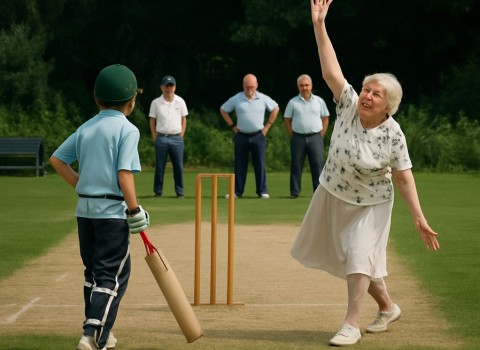
Afterwards, all five decided to stroll together into a nearby village, and came across a local cricket ground. The boys loved cricket, and it looked like a junior match was about to begin. “Can we watch?”, asked Alfred. “Of course”, came the reply, “we don’t have any umpires, though, which is a bit of a pain”. “I can umpire”, offered Griselda. “Oh, good show”, said the captain, “what a piece of luck. You can’t bat as well, can you”, he added jokingly, we’re a bit light there as well”. Griselda was full of surprises: “No, but I can bowl”, she replied. “We can bat”, said the boys in unison. “Well, you’re a bit young”, said the captain, “but why not? Excellent, now we have a full match”. Which they did indeed. Alfred acquitted himself particularly well. Socrates kept score. Plato helped with the cucumber sandwiches. There was a stage in the game when Griselda the umpire insisted on bowling an over. The old girl lumbered up to the wicket, a patently slow bowler as you’d expect, and bowled six of the wickedest googlies an adult has ever inflicted on a child. Children, actually, because she took three wickets. “Howzat”, she yelled each time, then giving herself the index finger. “This was the game played in its purest form”, Socrates would comment when they had a post mortem on it later that evening, “full of fun, eccentricity and inventiveness. That is why Crabtree and I decided it was valid as a learning day, too. In your study of history, you will see how games were destroyed by the Killjoys when they made them an international business. No fun anymore. Nothing to learn from life. Just rules. And money”.
The boys had readily agreed to calling it a learning day. Earning while enjoying yourself was pretty irresistible. But as always, there was a price. “Crabtree and I have placed some text on your devices. While watching the match, you must try to learn this text, known as a brain twister, defining the game of cricket, and be ready to recite it this evening. Good mental work for you. Work together to get it right”. This is what they had to learn, which Alastair could still rattle off many years later when he was an old man, to indulgent audiences who had heard it a hundred times before. He never forgot it, or that day.
You have two sides, one out in the field and one in. Each player that's in the side that's in goes out, and when they’re out they come in and the next player goes in until they’re out. When they are all out, the side that's out comes in and the side that's been in goes out and tries to get those coming in, out. Sometimes you get players still in and not out. When a player goes out to go in, the players who are out try to get that player out, and when that player is out they go in and the next player in goes out and goes in. Umpires stay out all the time and they decide when the players who are in are out. When both sides have been in and all the players have been out, and both sides have been out twice after all the players have been in, including those who are not out, that is the end of the game.
After the final cucumber sandwiches and sarsaparilla, it was time to return to the dock. “Goodbye boys”, said Griselda with a rather wistful smile, which momentarily turned into an emotional gasp as both of them rushed into her simultaneously for a big hug, nearly knocking her over.
Their new barge, which would take them as far as Londinios, was just as big as the last one, drawn again by two magnificent shires. Alastair’s interest in them, as in all creatures, was undiminished, but another creature occupied his attention from the very start – the boat’s skipper, Bessie. He fell instantly in love. She was indeed something to behold, a flaxen Saxon if ever there was one, with the spirit of Boadicea and eyes that could sizzle you – well, at least in Alastair’s case. The two teachers noticed it right away: “Early stirrings”, muttered Plato, and Socrates nodded sagely. “Come on, boys”, he said, “today’s learning isn’t finished and payable until you prove you have mastered your brain twister before dinner”. Alfred and Alastair struggled robustly with their recitations, and errors were mainly down to Alastair, who had something else on his mind, but Alfred bailed him out.
The next morning, both boys were woken early by an almost deafening cacophony of dawn choruses. They were used to the sounds of Nature, but this was an exaggerated and wonderful assault on the ears. They went out on deck and the birds were everywhere. On the rails, in the air, on the water, on the banks and in the trees. A celebration of life and of being alive. Alastair wondered what they were saying to each other, and recalled being taken to an opera at his local theatre. He didn’t really understand it, something about a sad clown, but he remembered some of the words the clown’s wife sang, “My mother understood the language of birds”, and these had stuck in his mind. He knew instinctively that humankind and other creatures of the earth had a rapport, but the codes had long been lost. He would spend a large part of his life trying to crack them. Meantime, however, he wondered how the skipper was getting on, and scuttled off to find out.
At breakfast, the boys signed in again with their teachers for a day’s learning, but no sooner had they finished their meal than Plato clapped his hand to his head and stuttered “My pain, my pain, it has me, oh goodness, it has me”. Socrates said to the boys “He’s having a migraine attack. Good heavens, Crabtree, it’s a long time since you suffered from one of those. What on earth has brought this on, I wonder?” Plato did look extremely unwell. “I need to lie down”, he said, “and you must fetch an apothecary”. “Yes, of course”, said Socrates, “come along, old chap, we’ll have to see how quickly we can find you one”. “Leave it to me”, said Alastair, “I’ll have a word with the skipper”. This knee-jerk offer was doubtless motivated in part by self-interest, but it was also true that both boys were very concerned for their teacher. Alfred and Socrates helped Plato back to the teachers’ cabin.