
Dichotomy
Part 6
By John Drewry
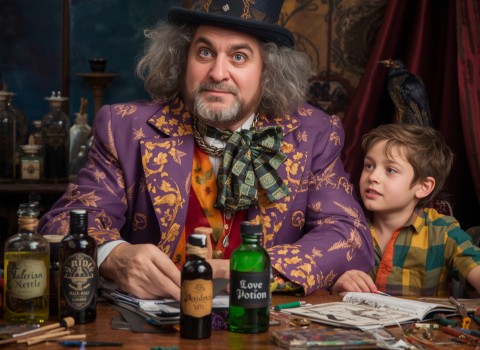
Meanwhile, the skipper checked her device and located an apothecary some three miles further on, so it wasn’t too long before the barge docked and a rather eccentric looking gentleman in very brightly coloured attire stepped on board. When Alastair saw him, he was immediately reminded of the sad clown he’d thought about earlier, except that this one looked all the time as though he was about to burst into laughter, and had the most twinkling, dancing eyes he’d ever seen. He carried with him a large, rosewood case that resembled an artist’s pochade box, and when he opened it up, instead of rows of paint tubes and brushes there was an equally colourful array of little vials containing liquids and powders. “Cross my palm with silver”, he said, holding out his device, and Socrates obliged with his own. It was the second time on their journey that the boys had heard this antiquated phrase for a financial transaction. “Thank you”, said the apothecary as he studied his screen, “I see you’ve suffered in the past from these, though not for some time”, he said to Plato, “what brought this on, I wonder? Ah, it seems that insufficient blood to the brain was the diagnosis before. I suspect the same now, looking at you, my lad”. Alastair was highly amused hearing one old man call another “my lad”. Maybe it was Plato’s boyishly smooth appearance. But it reminded him also of his great uncle Peter, who was the youngest of seven siblings, and nicknamed Baby Peter when he was born. The name stuck, however, so that at 83, as bald as a coot and the only remaining sibling, he was still known as Baby Peter by the extended family.
“Now let’s see”, said the apothecary, muttering into his portable medicine chest, “ah yes, Ginkgo biloba, tincture of leaves from the maidenhair tree, this should do the trick, stimulate the blood supply to the brain. Kill the cause, not the pain!”, he chanted, a little like a manic preacher. “All very well”, said Plato rather irascibly, “but can’t we do both?” “Patience, patience”, came the reply, “now drink this up like a good boy and then take your shoes and socks off”. The apothecary had a pestle and mortar, into which he chucked onions and horseradish, added a dollop of honey, and started vigorously mashing it all up into a paste, while muttering away like a mad professor. “Now, head forward, please”, he commanded, spreading the mixture on some coarse muslin and applying to the nape of Plato’s neck. “Feet up”, he continued, and did the same to the soles of Plato’s feet. “Good lad. Nearly done. Now you must lie down and get some sleep. A couple of drops of nectar from my little friend Valerian, I think, to help you on your way. There you are, drugged up to the eyeballs. Good night”. He swept out of the cabin like a whirlwind and was gone.
“Just a moment, apothecary”, called Socrates, running after him. He just managed to catch him. “Are you a registered teacher?”, he asked. “Yes”, came the reply, “I occasionally teach advanced medicine, very advanced medicine to mature students, why?” “Well”, replied Socrates, “Crabtree and I have been tutoring the two boys you saw, good boys, bright boys, and they signed in again this morning. Crabtree’s obviously out of service, at the very least for today. I’m History, and could handle them alone, but…” “You wondered if I’d be Crabtree for the day”, said the apothecary, finishing the sentence. “Yes”, said Socrates, “I think they regard you somewhat as a magician, as do I, I confess. It could bring some spice to the proceedings. What do you say?” The apothecary chortled and his eyes danced: “Let us embark upon this enterprise”, he responded, “yes indeed. I’d better let Mrs. Apothecary know I won’t be home until this evening”. Socrates knew that apothecaries avoided giving people their names, that they enjoyed playing to the mysteries of their dark arts. Often accused of being a secret society, they would always deny it on the basis that, if you knew about it, it was hardly a secret. Rather, it was a society of secrets, they would say.
The boys, however, immediately nicknamed him Deadly Nightshade, which they then abbreviated to Deadly. He was an entertainer, guaranteed to command attention as a teacher. Of course, as with most boys, they were fascinated by the lurid, and Deadly played to that. “I come from a long line of apothecaries and witches, going back to the 16th Century”, he said, “one of my forbears was burned at the stake”. “Cor”, chimed the boys. “Yes”, he continued, “but you’ll probably be disappointed to know that she felt no pain. She managed to mix herself a potion beforehand. It finished her off in peace as the flames engulfed her”. He momentarily played the dying witch, shaking his arms above his head to emulate the flames. The boys were enthralled. “It is no wonder they’ve been associated with quackery and showmanship down the ages”, Socrates thought to himself. He recalled the oldest known graffiti, scrawled in Vulgar Latin on the wall of Rome’s Colosseum: CACA AVERTO MEDICUS (shit well and avoid doctors). “Bet they didn’t replicate that bit in Robot City”, he mused.
“So, do you know any magic potions?”, asked Alfred. “I didn’t mention the word magic”, Deadly replied, “our profession is based on science, not superstition. It is Nature that is magic, we are merely its servants. Through the ages, the Killjoys did their best to exterminate our knowledge, by putting us on the bonfire and through ridicule. They made a joke of natural remedies”. “Why?”, asked Alastair. “Because there is no money in the ingredients of natural remedies”, Deadly replied, “everybody owns them. And in the previous epoch, when the Killjoys accumulated vast sums of money at the expense of everybody else, they discredited natural remedies as much as possible, to pave the way for their drugs. Drugs are synthetic concoctions, made by combining chemicals, body parts and poisons, which they could own exclusively and hold us all to ransom with huge prices. Ironically, this is where the true witches’ cauldrons were, diabolical places of animal sacrifice and demonic mixing under the magical spell of money.
“Remember, my lads, drugs don’t cure, they alter and deceive the body. They also addict the body, so you have to keep coming back for more. Of course, we have them today for emergency purposes. After all, if you break your leg in three places and are screaming in pain, I’m not going to potter around trying to mix you a potion. It's too late to kill the cause, I have to kill the pain. So I’ll inject morphia into you. Similarly, if you need surgery, they’re not going to cut you open while you’re still awake, like the Ancient Greeks did”, he said this with relish while wielding the imaginary knife, which made the boys shudder, “you’ll get a shot of anaesthetic. But real medicine is natural medicine. In the past, we lost our connection with the rhythms of Nature and her hand of friendship. Instead, the Killjoys thought they could tame Nature and tell her what to do. They thought farms could exist without farmers. They forgot the things Nature had taught them. How the spider and a little bird taught us how to weave. How our friend the bee provides the magical healing power of honey, and when crushed, poor fellow, gives us Apis mellifica, a very powerful cure for arthritic pain. How haemophilia can be stemmed with the meat of a raw chicken. Or arterial bleeding with the webs of the tiny cob spider, which is why in olden times they never brushed the cobwebs from the nooks and crannies – though it is true today that we have synthetic material in all our homes for the emergency of copious bleeding. How vinegar and brown paper are still, as the nursery rhyme tells us, a most effective treatment for bruises to the head.
“I tell you the simple things here. There is much more to it. But never forget, Nature is your friend and your mentor. Our buildings today are once again made from natural stone and wood. Synthetic building materials drain the spirit, which is why it’s not good to spend too much time in Robot City”. He held up an apple, and asked “Could humankind ever create such a wonderfully complicated thing? It is like no other apple. And where was this particular apple 200 years ago? Where will it be in another 200 years? Where were you 200 years ago, or even 20 years ago? Nature creates and disposes all the time, with invisible energy, every second. Learn to live inside her rhythms. She will always be the boss”.